Owala.
Everyone sold
Insulation
They answered
Sip through a straw or swig from the spout, in one bottle.
Lid( For DTC & e-commerce founders selling physical products, $300K to $1.5M a year )
Cheaper copies are pulling you into discounts. This 15-minute scorecard shows the signals telling buyers to compare you on price, and which leak to fix first.
Line up eight competitor pages. Six in sage green. Five in the same rounded font. Seven offering 15% off for your email. Following the herd is expensive. I’m a llama in a lilac visor, and nobody has ever mistaken me for the alpaca next door. Your store? Let’s find out.
Picture it. 9:02 PM on a Tuesday. Five tabs open. Meta: cost per purchase $52.40. ROAS down from 3.2 to 1.9. TikTok Shop: a copy of your product, running your slow-pour video, shot for shot, for $24. Yours is $52. And in Klaviyo drafts, a campaign called WEEKEND20. Last time you ran it, 38% of that weekend’s orders used the code. Your cursor is on Schedule.
You’ve probably already paid to fix it. An ad agency. A conversion sprint. An email agency. Each one fixed the thing they sell. None of them answered the one question a buyer asks with two tabs open: why is this one worth $28 more?
That’s an upstream problem. When your page makes the same claims as the three tabs next to it, ads push the sameness to more people, a cleaner site shows it faster, and discounts confirm it was never worth full price. Research on brand choice has found the same thing for decades: the more a brand promotes on price, the more price-sensitive its buyers become.
Every bottle brand sold insulation. Owala sold the lid. Every olive oil poured messily from dark glass. Graza put it in a squeeze bottle. Each answered the complaint the category ignored.
At Montos, we call it the Sameness Delta Protocol. Score. Rebuild. Re-score. It starts with the score. Try one now. Open your homepage. Cover your logo. Read your headline as if your cheapest competitor’s name were on it. If nothing stops being true, that’s one commodity signal. There are 19 more.
That’s the Brand Gap Diagnostic. 20 checks. 3 competitor tabs. 15 minutes. You get your Brand Gap Score out of 40, the leak to fix first, and the Margin Leak Calculator, which shows what your codes cost in dollars. At a 59% margin, a 20% code needs 51% more orders just to make the same profit. The link’s right below me.
Montos started when its founder dropped his own launch over a five-figure branding quote. So the score comes first, before anyone asks you for agency money. 15 minutes. 3 tabs. One honest number. Then you’ll know if you’re the herd, or the llama.
Owala is a registered trademark of Trove Brands, LLC. Graza is a trademark of its owner. Montos is not affiliated with or endorsed by either.
Prefer to read? The whole page is below ↓
One-time payment • Instant access • 30-day guarantee
19/40
The Discount
Death Spiral
⚑ Red flag: Positioning below Execution
19/40
The Discount Death Spiral
⚑ Red flag: Positioning below Execution
( Why it works )
8 years
of household buying data showed it: the more a brand promotes on price, the more price-sensitive its buyers become. See the study ↓
8 brands
escaped their herd the same way, from Owala to YETI: they answered the complaint everyone else ignored. See how ↓
20 checks
run on your own store against three competitor tabs you name, not brands in general.
( 01 · The scene )
Dinner is done, your partner is watching something in the other room, and you're sitting on the couch with your laptop open to five browser tabs:
Cost per purchase today was $52.40. Blended ROAS is sitting at 1.9, down from 3.2 in the spring. Four out of five orders still rely on Meta.
The last time you ran that 20% code, 38% of that weekend’s orders used it. For the next two weeks, hardly anyone paid full price.
Your cursor is resting on Schedule for Friday at 7:00 AM.
If you send it, you hit your monthly revenue target and give away your remaining margin. If you don't, the copycats take the sales.
You change the subject line twice, close the laptop, and tell yourself it’s the last time you'll discount.
That's what it looks like when buyers see your brand as a commodity.
15 minutes. Find out which signal is pushing you into WEEKEND20.
( 02 · What you’ve already tried )
If this feels familiar, it isn't because you haven't tried to fix it. Most founders in this position spend tens of thousands trying to solve this with specialists:
$24,500
1 · The Meta Ad Agency
They told you "creative is the new targeting" and ran 12 UGC videos a month. The ads launched at a 1.4% CTR, plummeted to 0.6% three days later, and burned out. Why? The ads sold the general category (a pretty product in morning light) while copycats sold the same visual for less than half the price.
$8,500
2 · The CRO Freelancer
They moved the review widget above the fold, made the add-to-cart button sticky, and added Shop Pay. Conversion bumped from 1.8% to 2.0% for a month, then settled at 1.7%. Why? A smoother layout only helped buyers see your $52 price tag faster before clicking over to the cheaper tab.
$18,000
3 · The Email Retention Agency
They built complex flows with 15% welcome popups and abandoned-cart discounts. They trained your buyers to wait for codes—which is why 38% of orders used the code the last time it ran.
Each specialist treated the symptom they sell. The ad agency saw a creative problem. The CRO freelancer saw a layout problem. The email agency saw a retention problem.
Agencies sell you more ads. Email agencies sell you more codes. Nobody fixes why buyers can’t tell you apart.
( 03 · The real problem )
The research
Deal-driven buyers react twice as hard to price
Average price sensitivity: how much a 1% price change moves which brand they choose.
Over 8 years, as promotions went up and advertising went down, the non-loyal group grew and became more price- and promotion-sensitive.
Think of your brand like a water source. If the spring is muddy, polishing the pipes downstream just gives you cleaner pipes carrying muddy water.
Positioning and perception sit upstream. Ads, CRO, and email sit downstream.
When your product page repeats the same claims as the three tabs next to it ("all-natural," "cold for 24 hours," "premium quality"), your brand sends an unmistakable Commodity Signal.
Three tabs, one page. So the buyer picks the cheapest.
Every dollar you spend downstream merely amplifies that signal:
Downstream · Ads
Ads push the sameness to more people.
Downstream · Site
A cleaner site lets them see the sameness faster.
Downstream · Offers
Discounts confirm that your product was never worth full price to begin with.
This isn't a hunch. A long-term study of brand choice found the same thing: the more a brand promotes on price, the more price-sensitive its buyers become. (Mela, Gupta & Lehmann, Journal of Marketing Research, 1997) ↗
Until your brand gives buyers an evidence-backed reason to choose you by name, every marketing dollar you spend is funding the price war.
Find your commodity signals in 15 minutes.
( 04 · The antidote )
Agencies start brand work with a mood board, a brainstorm, and a list of adjectives like "elevated." Those are the exact same words your competitors came up with in their own rooms.
The Sameness Delta Protocol™ starts with counts and evidence instead:
What 3 competitors claim
What their buyers complain about
The brands that escaped their herd didn't out-advertise it. They answered the complaint everyone else ignored.
Owala.
Everyone sold
Insulation
They answered
Sip through a straw or swig from the spout, in one bottle.
LidGraza.
Everyone sold
Dark glass and a messy pour
They answered
A squeeze bottle, and two oils named for what you do with them: Sizzle and Drizzle.
SqueezeAthletic Brewing.
Everyone sold
Watery non-alcoholic beer that felt like an admission
They answered
One that stands up to craft beer, and makes ordering it something to be proud of.
TasteEmber.
Everyone sold
Mugs that let coffee go lukewarm
They answered
Coffee held at the temperature you set, sold for $100+ when people said nobody would pay that for a mug.
HeatDyson.
Everyone sold
Bags that clog and lose suction
They answered
A bagless vacuum, with "doesn't lose suction" as the whole message.
SuctionOXO.
Everyone sold
Thin metal handles that hurt to hold
They answered
A fat, soft grip, then the same for every tool in the drawer.
GripSpanx.
Everyone sold
Pantyhose you cut the feet off to hide panty lines
They answered
They turned that hack into a product.
HackYETI.
Everyone sold
Cheap ice chests with handles that broke and lids that caved in
They answered
A cooler tough enough to stand on in a fishing boat, sold for $300+ when most were a fraction of that.
ToughOwala, Graza, Athletic Brewing, Ember, Dyson, OXO, Spanx and YETI are trademarks of their respective owners. None is affiliated with or endorses Montos. Examples describe each brand's publicly reported product story.
( 05 · Introducing )
The 15-minute scorecard for DTC founders
Created by Montos, The Brand Gap Diagnostic™ is a 20-point diagnostic scorecard that pinpoints the exact signals telling buyers to compare you on price.
Open your store in incognito, open three competitor tabs, and complete this 15-minute diagnostic to see exactly which leaks are suppressing your contribution margin. You finish with your Brand Gap Score out of 40, broken down into Positioning, Message, Perception and Execution & Offer.

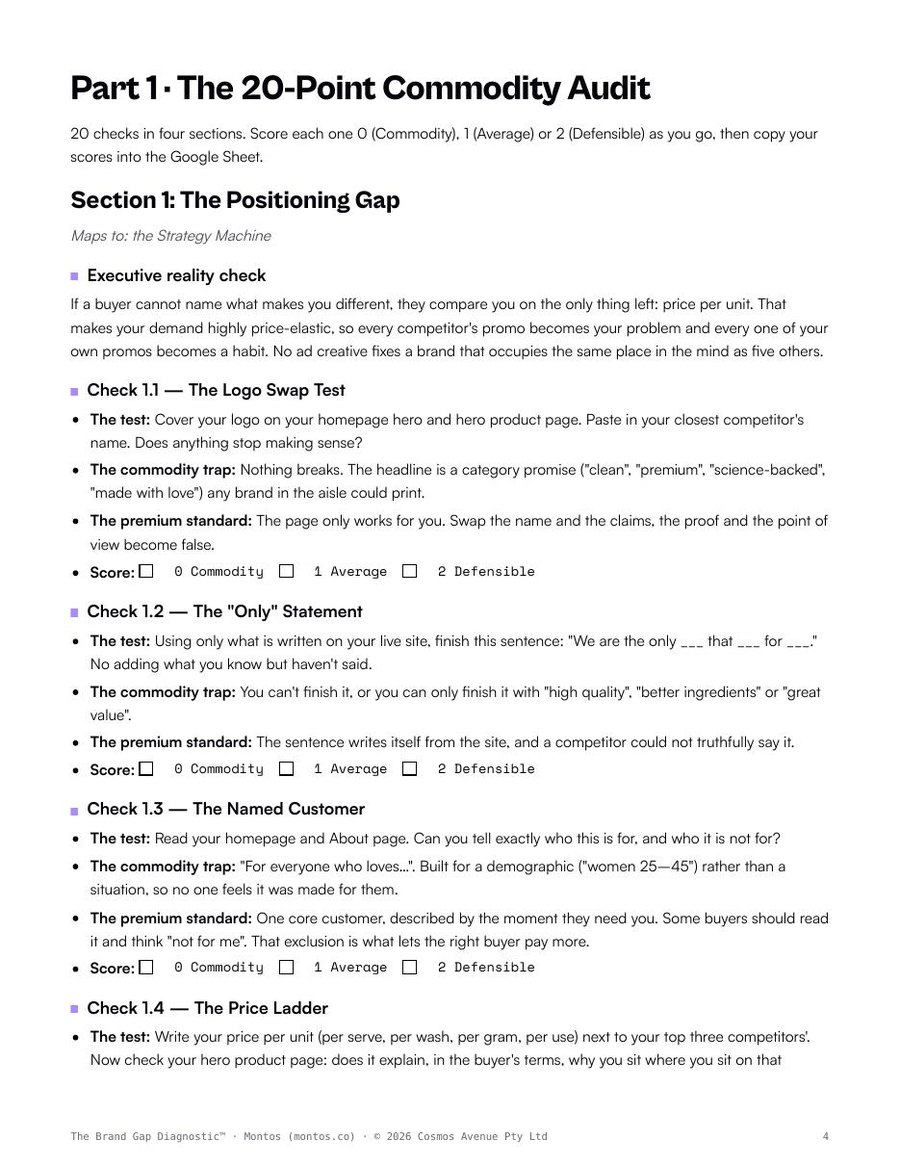
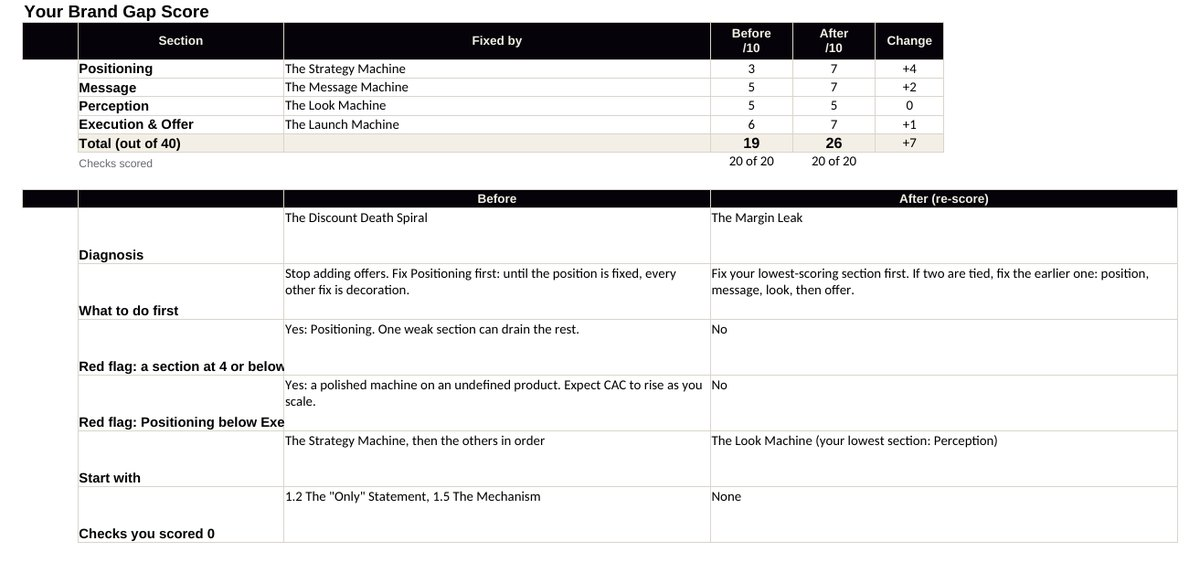
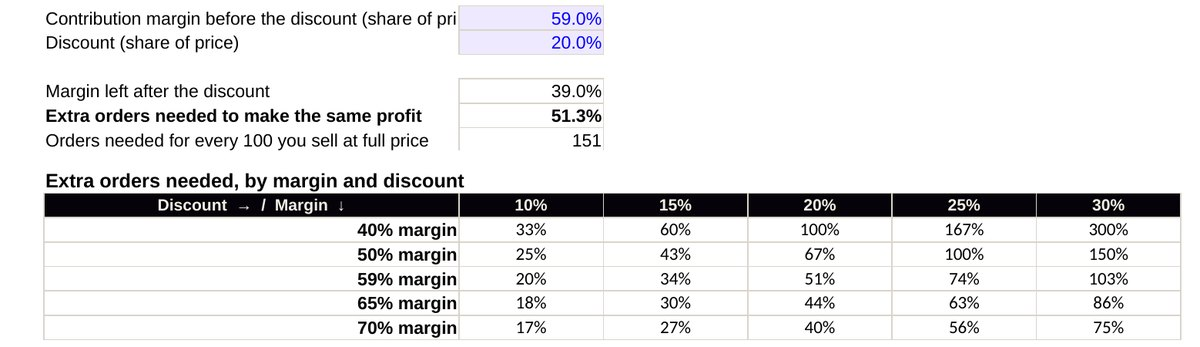
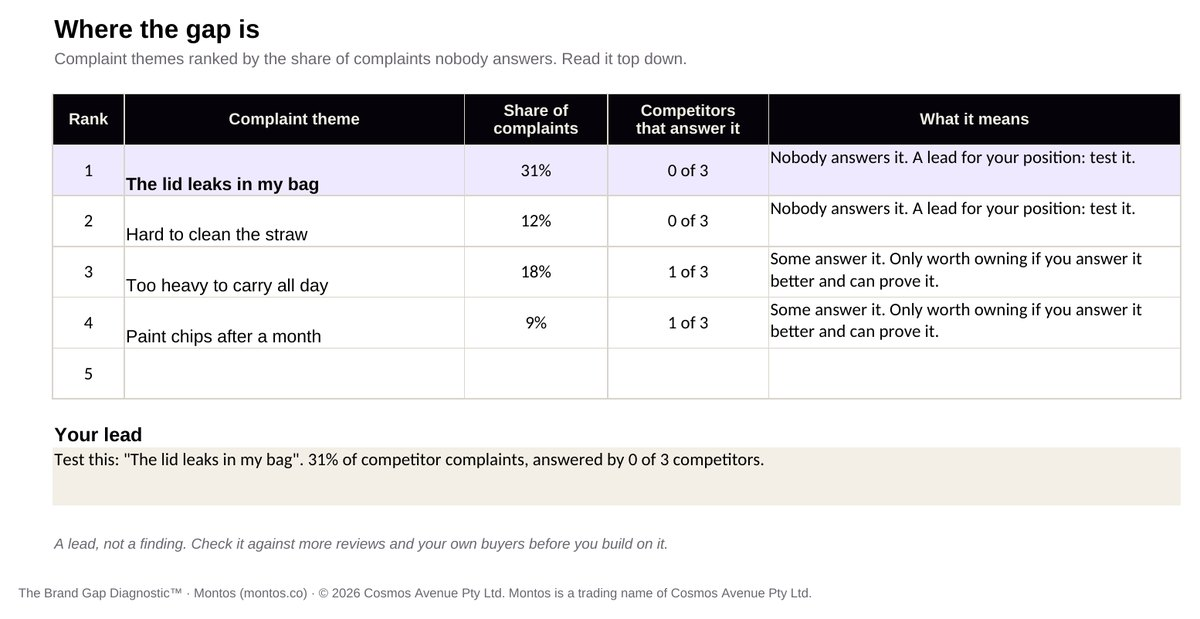
The real files, filled in for an illustrative brand. Your numbers will differ.
One-time payment • Instant access • 30-day guarantee
( 06 · Try it now )
Open your homepage. Cover your logo. Read your headline as if your cheapest competitor's name were on it. Does anything stop being true?
If nothing breaks, that's one commodity signal. There are 19 more checks.
Illustrative homepage
Press the button to swap in your cheapest competitor’s name.
One-time payment • Instant access • 30-day guarantee
( 07 · Before and after )
The same Tuesday night, with the diagnostic done.
From a 20% code sitting in drafts to your Brand Gap Score out of 40, the one leak to fix first, and the order to fix it in: Position → Message → Look → Offer.

One-time payment • Instant access • 30-day guarantee
( Why Montos exists )
Montos started with a detergent sheet brand that never launched. In 2023 the branding quote came back at five figures, and the launch was dropped.
The question stayed. It led to training in brand strategy, and one pattern kept showing up: most product sellers put their effort into the product and the ads, and almost none into the brand. So the copies arrive, the ads cost more, and the discount codes come out.
Montos is the method that founder wanted, and the Machines run it. The Diagnostic is the first step: you see where you look like your competitors, and what it’s costing you, before anyone asks you for agency money.
 — Monty
( 08 · What’s inside )

20 live tests across the 4 critical brand gaps: Positioning, Message, Perception, and Execution & Offer. Each check is scored 0 (Commodity), 1 (Average), or 2 (Defensible).
Formulas that translate each brand gap into real dollars using your own numbers:
An objective diagnosis based on your Brand Gap Score out of 40:
A prioritized 1-page action sheet that maps the exact order to fix your leaks (Position → Message → Look → Offer) with a worksheet for your three immediate fixes.
A template and 2-page SOP for collecting and counting competitor claims against customer reviews. Stop brainstorming adjectives in your head and find category whitespace in your buyers' own words.
( The real cost )
At the numbers in the 9:02 PM scene (about 1,000 orders a month on a $52 product, with 38% using the 20% code, as they did last time), 380 orders a month use the code. That's about $4,000 a month in margin, or nearly $48,000 a year, handed back to buyers who would likely have paid more.
The Diagnostic is $27. Run your own numbers in the Margin Leak Calculator.
Illustrative figures.
The Brand Gap Diagnostic™
TOTAL VALUE $455
$27
Get The Brand Gap Diagnostic™ — $27One-time payment • Instant access • Auto-calculating sheet included
The 30-Day Margin Guarantee. Don’t find at least three commodity signals? Email us within 30 days for a full refund. You keep everything.
Run your store through the 20 checks against three competitor tabs.
If you don't uncover at least three specific commodity signals on your site that are actively suppressing your margins and training buyers to wait for discounts, email us within 30 days for a full refund.
You keep the audit, the calculator, and the worksheets.
Get The Brand Gap Diagnostic™ — $2730-day guarantee. You keep everything.
( 09 · Questions )
15 to 20 minutes. Open your site, open three competitor tabs, and score each check 0, 1, or 2.
No. Every check is something you can see on the page, and three of the 20 work best with a second pair of eyes: someone who doesn’t know your brand. If your hero copy says "all-natural ingredients" and your competitor says "all-natural ingredients," you score a 0 on the Logo Swap Test.
You receive a clean, printable PDF scorecard and an auto-scoring Google Sheet (with an Excel download included).
Yes. The Upstream Fix Sequence outlines the order of operations, and the scorecard includes clear guidance on which Montos Machine to use to rebuild your brand yourself.
Yes. Run the checks on your listing instead of your homepage, against the three listings that sit next to yours in search. Your title and first bullet take the Logo Swap Test. Your main image takes the Thumbnail Test, which is built for search results. Your coupons and deals take the discount checks. On Amazon, buyers see you side by side with the copies before they click, so the same signals show up there.
No. The Diagnostic only scores your store; it doesn’t change anything. A low score doesn’t mean a rebrand. Often the fix is a sharper headline, a different first offer, or a line that answers a buyer’s doubt. Keep what’s working, fix one leak at a time, and re-run the checks to see what moved.
Yes. It’s built for stores that are already selling. It scores the store you run today against three competitors, so there’s nothing to launch. You get the lines and offers to change on the store you have.
Only if a buyer can see it in five seconds. Check 1.5 (The Mechanism) tests exactly that.
Then you've spent $27 learning your margin problem is somewhere else, and the Fix Sequence tells you where to look. We'd rather tell you that than sell you a rebuild.
Because it’s the first step, not the fix. Montos exists so you can see the leaks in your store before anyone asks you for agency money.
You get instant access to the PDF scorecard, the auto-scoring Google Sheet, the calculator and the worksheets. Open your store and three competitor tabs, and you can start straight away.
No. One payment of $27. The files are yours to keep.
Yes. Everything in the video is on this page, and there’s a transcript under the video.
If you’re doing $300K to $1.5M a year, it’s built for you. The checks are simple to run. The hard part is seeing your own store the way a buyer with two tabs open sees it, and that’s what the score shows you.
Fair. Most of those teach a tactic. This one scores your own store against three competitors you name, so what you get back is about your brand, not brands in general. And if you don’t find at least three commodity signals, the 30-day guarantee gives you your money back.